Dear Families of 4-324,
As you probably know, we have our fantasy reading unit going on, and we need the rest of the Dragon Slayers Academy series, from books #6 to 20. Two of the book clubs are reading the books for their unit. Also, we do love the books and want to read the whole series too. We read the first book in the series as a class, and we thought it was hilarious. So, if you are able to donate one of the books for the series, we would appreciate it. Or, if you have any at home that you could send in, that would be great too.
We added the books to our Wish List.
Thanks,
Class 4-324
Friday, February 10, 2012

The Bike Race (by Edison)
Katie's mom is in a bike race over the February break. Our class got to make maps of the bike race to help her figure out where all the resting points are along the race. As mathematicians, we go tot think mostly about fractions, such as 1/2 of 60, 1/3 of 60, etc. We worked in pairs and 3s. We made the maps because the people holding the race sent Katie's mom the way she would go, but they didn't tell her where exactly the different stations will be, like cheering stations, resting points, water stations, food wagons, and juice and snack stations. Each of the stations was a different amount of miles into the course. The course is 60 miles long.
Here we're studying the maps our classmates made and leaving them feedback on their work. We'll post pictures of our maps for you later on!


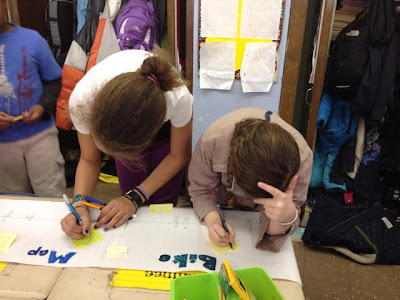


Here we're studying the maps our classmates made and leaving them feedback on their work. We'll post pictures of our maps for you later on!


Tuesday, February 7, 2012
Historical Fiction Picture Book Publishing Expectations
Historical
Fiction Picture Book Publishing Expectations
We
just finished a month-long unit on historical writing in class. Our pieces
focused on life in 1620 and 1621, either on the Mayflower, in Plymouth or in a
neighboring Wampanoag village. We pulled on our knowledge from our readings and
from our social studies work to make our pieces the strongest they could be.
During
this unit, we focused on:
·
Creating three or four clear
scenes that each tie in to the main problems in the piece
·
Building the meaning in our
piece by layering small actions, internal thoughts, dialogue and setting
details
·
Bringing out the historical
story (what was actually happening in 1620) and the personal story (what was
happening specifically to our character)
·
Creating characters that are
flawed and realistic and revising our piece to ensure our characters are more
than one way
·
“Turning the lights on” in
our piece so that the setting is clear to our reader
Significant
time was allotted to this project in class, and your child already should have:
·
Created a rough draft of their historical fiction piece
·
Revised their historical fiction piece based on the above lessons
·
Edited their historical fiction piece alone and with a partner
·
Written a draft of a nonfiction introduction
·
Created at least three illustrations for their the book
Your
child will have until Friday, February
10 to work on publishing their historical fiction picture book at home. The
finished piece should include:
c A cover with a title and the author’s
name
c A nonfiction section at the beginning that
includes information about at least two different parts of life at this time
(ex. The Wetu and Life in a Wampanoag Village)
c A typed or handwritten story that has at
least 3 scenes (It is alright if the story is typed by an adult.)
c Illustrations—at least one for each
scene, but more illustrations if wanted
Tuesday, January 17, 2012
Social Issue Book Clubs (by Freya)
Social issues in our books aren't just naming the social issues. They teach us different ideas about the social issues. Like "Sammy and the Time of the Troubles." Sammy still knows war is horrible, but he starts to get used to it. Other books show war as something that scars your body because your family and the people you live die. Another example is the social issue death in "Esperanza Rising." Her father's death scars her life forever because after he dies, Esperanza and her mom are at the mercy of their mean and horrible relative. In other books like "The Bridge to Terabithia" it is a big pressure to Jess when his only and best friend dies.
Social issues teach you something important, but some ideas conflict. Which ideas do you agree with?


Arrowheads

Today we had a special presentation by Will. He brought in Iroquois arrowheads for us to study, and he taught us everything he could about them. We were filled with questions, and we got several great ideas for our historical fiction pieces.
Tuesday, December 6, 2011
A Columbus Comic (by Louise)
I know so much about Christopher Columbus, and I wanted to show some of it in a child-fun way. So I decided that I would Write and draw a comic on Columbus. I hope after reading it, you will say to yourself, "Wow, I just learned a ton!!" Then please help your self to reading and learning as much as you can about Christopher Columbus. Click on any picture to view it larger!


Why Some People Think Christopher Columbus "Discovered" America (by Zora))
Some
people think Christopher Columbus “discovered” America but he really
didn’t. One reason he didn’t is
that native people were there for hundreds of years. Another reason is people like Leif Eriksson sailed to
America but just didn’t stop to make settlements. I guess the reason of that is because the Europeans [the or
Spanish] didn’t know about the New World [North America] and accepted
Christopher Columbus as the “discoverer” who brought them aware that a
continent was there. Though it’s
funny because the Europeans [or the Spanish] thought Christopher Columbus had
just come across a much faster and safer way to sail to China.
Subscribe to:
Posts (Atom)